High-Fidelity Photography · Computational Reflective Imaging

The photograph
as an event of
light and matter.

Not print. Not screen. Not lightbox.
A photographic image resolved by computed reflection — encoded into polished material itself, fed by real light, and able to change as the viewer moves through it.

The founding claim

A photographic image that appears.
Not one merely deposited on a surface.

Photography has largely lived in two image-forming regimes: absorptive prints and emissive displays. Flective photography opens a third. The image is neither printed nor emitted. It is resolved through deterministic reflection from a computed surface.

Each reflective pixel is angled to redirect selected incoming light toward selected viewer positions. Together these facets construct a photographic image from the light already present in the space, or from a prepared light field when stricter control is desired. The image is not stored as pigment density. It is carried by the geometry of the object itself.

"The image is not always there in the usual way. It arrives. From the wrong position: a reflective object. From the right position: a photograph."

This changes the ontology of the photographic object. A Flective photograph is not a paper print behind glass, not ink on metal, not an LED panel disguised as an artwork. The object itself becomes the image-forming instrument. The image that matters most is the image that does not fully preexist as a continuously visible deposit.

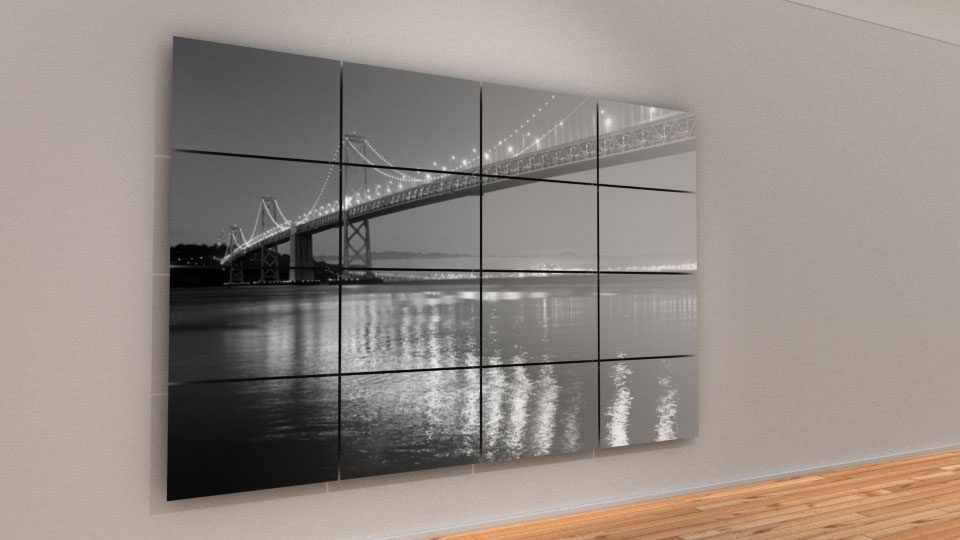
It also changes what photography can feel like. Bright highlights are not bounded by paper white. Dark structure is not raised by panel glow. Viewer motion can reveal different emphases within the same image. A night scene can remain genuinely dark while still carrying sharp luminous accents. Chrome, water, glass, city lights, portrait highlights, distant haze — all can be handled by a system whose palette is drawn from real light rather than from ink limits or fixed display primaries.

What kind of photographic object this is
Category One
Emissive
Generates light · requires power
Screens, OLEDs, LED walls, projectors. Bright and flexible, but dependent on electronics, software, maintenance, and continuous power.
Category Two
Absorptive
Absorbs light · pigment-based
Silver gelatin, inkjet, chromogenic print, pigment on substrate. Fixed, elegant, and historically central — but bounded by paper white, chemistry, and fade pathways.
Category Three — New
Reflective
Redirects light · geometry-based
Mirror-pixel arrays computed into durable material itself. No image layer to bleach. No backlight. No fixed primary grid. Viewer-responsive. Site-aware. Permanently structural.

The distinction is not merely visual. A Flective photograph is a photographic subject rendered by a different image-forming principle. It is best understood not as a better print, but as a new class of photographic object.

Five distinctive advantages

Five ways this medium changes
photographic display.

These are not decorative extras. They follow from the actual image-forming method: computationally prescribed reflective geometry drawing from a real or prepared light field.

I
The Image That Isn't There
Conditional visibility rather than continuous deposit
From off-axis, the work may read as a refined reflective object. In the designed viewing zone, the photograph resolves. This gives the medium an arrival effect unavailable to standard prints and fundamentally different from always-on display logic.
II
Freeform Reflective Color Space
Palette drawn from available light rather than fixed primaries
Each reflective pixel gathers what the environment or prepared field can supply. That means the effective palette is not limited to a fixed RGB subpixel architecture or to subtractive print chemistry. It is site-specific, unusual, and potentially much richer in certain image classes.
III
Walking Transitions
The photograph can be composed to reward motion
As the viewer moves, emphasis can shift. Depth relations can strengthen. A hidden secondary image can emerge. The work can be authored so that walking through it is part of seeing it. This is native to the medium, not a gimmick added on top.
IV
Extreme Tonal Reach
Not bounded by paper white or panel glow
Bright accents can remain truly bright because they are fed by reflected illumination rather than by paper reflectance. Dark passages can remain materially dark because the surface is not backlit. High-contrast photographs therefore become an especially fertile territory.
V
Permanence of Structure
No print chemistry, no dimming panel, no image layer to delaminate
The image is encoded into material form. There is no conventional print fade pathway and no electronic display lifecycle. The photographic object can therefore occupy a position closer to sculpture, medallic relief, architectural metalwork, or durable memorial fabrication than to normal photographic display products.
The physical object

Photography
beyond print.
Permanent in matter.

A Flective photographic work is not a photograph mounted onto a reflective substrate. The image is produced by the substrate itself. The surface geometry is computed and fabricated so that the object resolves the image through reflection.

No paper white. No pigment layer. No screen glass. No backlight. No ordinary fade logic. The photographic artifact becomes a polished object whose visual life depends on light, position, and authored geometry.

This format is especially strong where conventional photography strains against its own medium limits: luminous night work, metallic subjects, water, glass, portrait highlights, urban reflections, architectural interiors, memorial portraiture, and any image in which movement through the image can matter as much as standing still before it.

It is also well-suited to permanent placement. Collector editions on polished aluminum, institutional works, lobby installations, commemorative portraits, and public photographic pieces can all benefit from a medium that behaves more like durable crafted matter than like consumable display hardware.

Medium properties
Image Mechanism
Computed micro-geometry redirects selected incoming light toward selected viewer positions. The image is optically resolved from reflection, not stored in dye or pixels that emit.
Color Space
Environment- or source-dependent reflective palette. In prepared settings this becomes a designed freeform color space rather than a fixed display-primary architecture.
Dynamic Range
Potentially unusual coexistence of bright highlights and deep blacks, because the work is neither bounded by paper white nor compromised by panel glow in the usual way.
Walking Behavior
Viewer movement can reveal authored transitions, deepen certain regions, shift emphasis, or expose hidden layers. The work can be composed for approach, pass-by, and departure.
Substrates
Polished aluminum alloy, glass, and related reflective materials. Each substrate introduces its own optical character, finish discipline, and fabrication pathway.
Durability
Structural image encoded into durable material. No conventional print chemistry and no consumer-display electronics stack. The object inherits the longevity logic of its substrate and finish.
Photographic territory

What photography can do here
that it cannot do elsewhere.

The point is not to replace paper photography or screens. It is to open a distinct branch of photographic culture: the image as reflective object, responsive encounter, and durable crafted matter.

I
High-Fidelity Fine Art Photography
Photographic works rendered in a reflective image-forming medium rather than in absorptive print chemistry. This allows a different relationship to luminance, darkness, specularity, and objecthood. The result is not merely a richer print but a different kind of photographic artifact.
Collector editions · gallery placement · flagship photographic works
II
Night, Chrome, Water, Glass
Subjects built from highlights, reflections, and deep shadow become newly natural here. Reflective means can depict reflective subjects with unusual authority.
Specular subjects · urban light · difficult tonal material
III
Portraiture with Presence
Portraits can acquire a subtle life through motion-linked change. Not animation, not lenticular novelty, but a static object with a perceptual response authored into the surface.
Portrait commissions · memorial portraiture · public recognition
IV
The Image That Arrives
A photograph can be hidden in plain sight and then appear as the viewer enters the correct zone. This arrival effect introduces drama, discretion, and a genuinely new phenomenology of display.
Threshold experiences · approach-based reveal · quiet spectacle
V
Walking Photography
The work can be composed for motion. One aspect clarifies in approach, another in passing, another in retreat. The photograph unfolds temporally without becoming video.
Path-based viewing · progressive reveal · movement-authored seeing
VI
Architectural Photography as Architecture
A photographic image can be made into durable metal or glass for lobbies, public spaces, memorial settings, and permanent architectural placement. The display object becomes a built object.
Lobby art · institutional commissions · public photographic installations
VII
Prepared-Light Masterworks
Although ambient light is often the feedstock, this photographic branch can also be paired with designed light fields for exhibition-grade control. That preserves the reflective ontology while allowing more exact control over palette, brightness behavior, and the timing of appearance. In that form the medium becomes a serious candidate for museum-grade photographic display, flagship edition work, and historically important demonstrator pieces.
Controlled installations · exhibition-grade conditions · flagship photography
One flagship direction

High-fidelity photography:
the first and most culturally legible wedge.

Among the many territories opened by Flective imaging, photography is the most immediately legible and perhaps the most historically sensitive. It plugs into an existing and serious culture of looking: printmaking, tonal fidelity, darkroom traditions, gallery display, edition logic, collecting, and the long argument about what a photographic object is.

That is precisely why it matters. This is the branch where the medium can be judged by people who care deeply about image quality, tonal subtlety, permanence, surface character, and the legitimacy of a new photographic object.

Handled properly, this branch becomes not a novelty product but a major artistic and cultural argument.

Photographic Advantages
Why this wedge matters
A medium that can argue simultaneously on image quality, object quality, permanence, movement-linked seeing, and historical seriousness has unusually strong footing as a flagship introduction to Computational Reflective Imaging.
Cultural fitPhotography already has collectors, curators, institutions, and a refined language of judgment
Technical strengthUnusual tonal reach, freeform reflective palette, and authored walking behavior
Object statusNot merely displayed photography, but a new kind of photographic object
PlacementCollector editions, cultural institutions, memorial work, architectural installation
Historical forceA serious candidate to reopen the question of what photography can be in material form
About the broader medium

For Photographers

Working in this medium does not mean abandoning photography. It means translating photographic intent into a different image-forming system. Composition, subject choice, tonal discipline, reflective behavior, and viewing path all become newly important.

Some photographs are naturally suited to the medium: night scenes, reflective surfaces, portraits, architectural interiors, luminous weather, high-contrast city scenes, water, glass, and image concepts that benefit from delayed arrival or progressive reveal.

The photographer brings the image judgment. The Flective pipeline translates that judgment into a reflective angle field calibrated for where the work will live and how it should appear there.

Begin a photographic conversation

For Collectors, Curators & Institutions

Acquiring a Flective photographic work means acquiring a physically unusual photographic object: durable, materially present, and not dependent on the usual print or display maintenance cycle. The work belongs to the tradition of photographic culture, but not to the usual manufacturing logic of photography.

Placement matters. These works can be authored for a specific room, a specific path of approach, a specific light environment, or a specific prepared-light condition. That site-specificity is not a flaw. It is one of the medium's strongest artistic properties.

For institutions, this creates a new category of photographic acquisition: one that behaves less like a fragile print and more like a permanent crafted object with serious visual life.

Acquisition inquiry
The branch is open

A new photographic medium.
A first serious conversation.

Whether you are a photographer, collector, curator, architect, or institution, the conversation begins with the image, the light field, the viewing path, and what kind of photographic object ought to exist there.

Begin a Conversation About Flective →