Copied ✓

A photographic image that appears.
Not one merely deposited on a surface.

Photography has largely lived in two image-forming regimes: absorptive prints and emissive displays. CRI opens a third. The image is neither printed nor emitted. It is resolved through deterministic reflection from a computed surface.

Each reflective pixel is angled to redirect selected incoming light toward selected viewer positions. Together these facets construct a photographic image from the light already present in the space. The image is not stored as pigment density. It is carried by the geometry of the object itself.

"The surface is permanent. The image is alive."

This changes the ontology of the photographic object. A CRI work is not a paper print behind glass, not ink on metal, not an LED panel disguised as an artwork. The object itself becomes the image-forming instrument.

Bright highlights are not bounded by paper white. Dark structure is not raised by panel glow. A night scene can remain genuinely dark while still carrying sharp luminous accents. Chrome, water, glass, city lights, portrait highlights — all handled by a system whose palette is drawn from real light rather than from ink limits or fixed display primaries.

Three classes of photographic display.
CRI is the third.

Absorptive
Silver gelatin, inkjet, chromogenic print. Fixed, elegant, historically central — but bounded by paper white, chemistry, and fade pathways.
Emissive
Screens, OLEDs, LED walls, projectors. Bright and flexible, but dependent on electronics, software, maintenance, and continuous power.
Reflective
Mirror-pixel arrays computed into durable material. No image layer to bleach. No backlight. No fixed primary grid. Uncapped dynamic range. Permanently structural.

Not a better print. A different kind of photographic object — and in the right conditions, a higher one.

Ray-traced simulation · not footage of a fabricated piece

A walk-by of a Flective
photographic panel.

A solid slab of aluminum — approximately 4 feet tall by 7 feet wide, polished to a mirror finish. No colorants. No electronics. Just a mirror.

The front surface is precisely faceted according to the patented CRI method, back-calculated from the desired image. The pattern redirects select portions of incident light, converting it into images and visual effects.

The color is not printed. It is not emitted. It is ambient light redirected by computed surface geometry — resolved by the viewer's position and the light already present in the space.

This simulation is rendered from the computed surface geometry using ray tracing. A fabricated aluminum panel built to these specifications would produce this physical behavior.

High-resolution prototype · principle demonstration

The wall label
becomes the photograph.

In conventional gallery display, the wall label sits beside the work. In a Flective work, the label can be its first channel.

From off-axis, the panel displays its own provenance — title, camera, exposure data, artist name. Move into the viewing zone and the photograph resolves on top of it.

The information and the image occupy the same object. They are sequenced by where you stand. The provenance is not appended to the work. It is part of the work.

Conventional vs. Flective Display
Conventional
Flective
Label beside the work — separate object
Label encoded into the work — first channel
Image always visible to all viewers equally
Image resolves only from the designed position
Provenance is appended
Provenance is authored into the surface
Label and image compete for attention
Label and image are sequenced by the viewer

An early low-resolution
proof of concept.
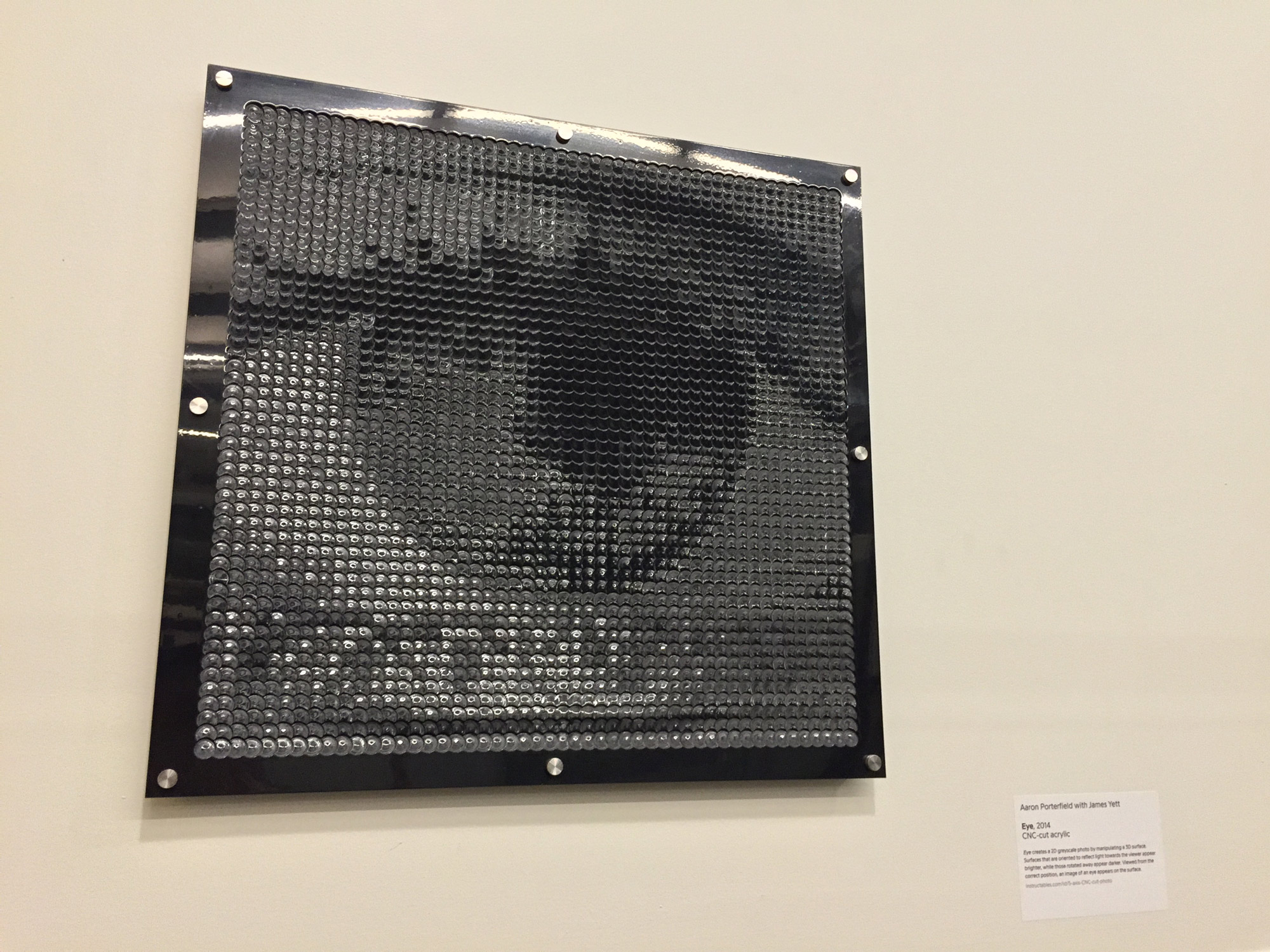
Eye — CRI proof of concept, Autodesk Pier 9 gallery, 2014
Eye · Aaron Porterfield with James Yett · 2014 · CNC-cut acrylic · Autodesk Pier 9 · San Francisco · Acquired for the Autodesk permanent collection
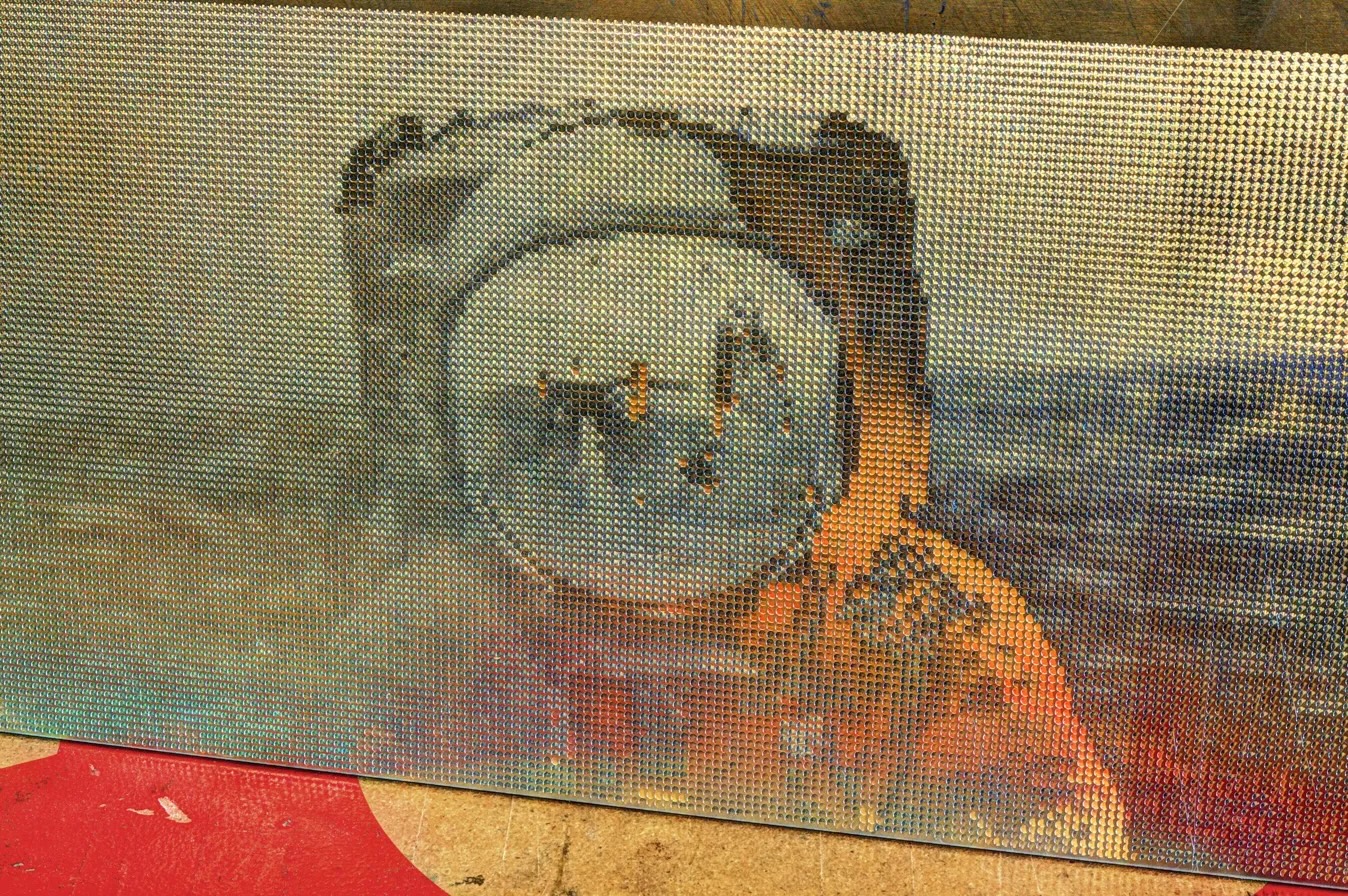
Early color CRI test
Early aluminum substrate · 5-axis CRI milling test · pre-mirrorization state

A deliberately low-resolution physical realization of CRI, produced in 2014 during an invited Autodesk residency in San Francisco, co-developed with fabrication artist Aaron Porterfield using Autodesk's industrial CNC and casting resources.

The piece — The Eye — is a 30×30cm panel of black cell-cast acrylic, its surface machined to approximately 2,500 facets. Each facet is a discrete mirror-pixel, angled to redirect a portion of the surrounding light field toward a designed viewing position. The image that resolves from that position is a portrait — formed entirely by reflection, not by pigment or electronics.

Produced at Autodesk's invitation, using Autodesk's fabrication infrastructure, and subsequently acquired for the Autodesk permanent collection — early external validation of CRI as a serious fabrication and imaging discipline.

Everything built since is an elaboration of what this object first confirmed. The resolution will improve. The principle is the same.

The boundaries of photography
have been redrawn before.

Each chapter in the history of photography was not an improvement on the last. It was a change in what photography fundamentally is. Every chapter opened new territory without closing the one before it.

1826
The Daguerreotype
Light imprinting itself on polished silver for the first time. The photographic image becomes possible.
1888
Roll Film
Photography becomes personal. Kodak places the medium in anyone's hands. The snapshot enters the world.
1935
Kodachrome
Photography gains the full visible spectrum. Color becomes a medium for documentary truth.
1969
The Digital Sensor
Photography separates from chemistry. The image becomes a signal — immediate, infinitely reproducible.
2009 —
Computational Reflective Imaging
Photography separates from deposition itself. The image is no longer printed, emitted, or stored as a layer. It is resolved, through computed geometry, from the light already present in the world. The photographic object no longer merely exists. It arrives — when the viewer reaches the right position, in the right light.

CRI does not replace the print or the screen. It opens the third branch of the medium — the image formed by reflection rather than deposition — and sets a new ceiling for what photographic display can be.

Five ways this medium changes
photographic display.

These follow directly from the image-forming method: computationally prescribed reflective geometry drawing from a real or prepared light field.

I
The Image That Arrives
From off-axis, the work reads as a refined reflective object. In the designed viewing zone, the photograph resolves. This arrival effect is unavailable to standard prints and fundamentally different from always-on display logic.
II
Uncapped Fidelity
With a designed engineered light field, a CRI display surpasses every prior photographic display method in dynamic range, colour gamut, and tonal fidelity. No paper white ceiling. No black floor raised by backlight. The palette is drawn from real light — as bright and spectrally rich as the light field you design.
III
Walking Transitions
As the viewer moves, emphasis can shift. A hidden secondary image can emerge. The work can be authored so that walking through it is part of seeing it. This is native to the medium — not an added feature.
IV
Extreme Tonal Reach
Bright accents remain truly bright because they are fed by reflected illumination. Dark passages remain materially dark because the surface is not backlit. These coexist in the same panel — something no print and no display achieves simultaneously.
V
Permanence of Structure
The image is encoded into material form. No conventional print fade pathway and no electronic display lifecycle. The photographic object occupies a position closer to sculpture, architectural metalwork, or durable memorial fabrication than to normal photographic display products.

Photography beyond print.
Permanent in matter.

A CRI work is not a photograph mounted onto a reflective substrate. The image is produced by the substrate itself. The surface geometry is computed and fabricated so that the object resolves the image through reflection.

No paper white. No pigment layer. No screen glass. No backlight. No ordinary fade logic.

This format is especially strong where conventional photography strains against its own limits: luminous night work, metallic subjects, water, glass, portrait highlights, urban reflections, architectural interiors, memorial portraiture, and any image in which movement through it can matter as much as standing still before it.

Image Mechanism
Computed micro-geometry redirects selected incoming light toward selected viewer positions. The image is resolved from reflection, not stored in dye or pixels that emit.
Color Space
With a designed engineered light field: a freeform reflective palette unconstrained by fixed display primaries or print gamut ceilings. The richest colour space in photographic history.
Dynamic Range
True deep blacks and genuinely bright specular highlights coexist in the same panel — something no print and no display achieves simultaneously.
Walking Behavior
Viewer movement can reveal authored transitions, deepen certain regions, shift emphasis, or expose hidden layers.
Substrates
Polished aluminum alloy, glass, and related reflective materials. Each introduces its own optical character and fabrication pathway.
Durability
Structural image encoded into durable material. No conventional print chemistry and no consumer-display electronics stack.

What photography can do here
that it cannot do elsewhere.

Not a replacement for print or screen. A distinct branch of photographic culture: the image as reflective object, responsive encounter, and durable crafted matter.

High-Fidelity Fine Art Photography
The highest dynamic range and widest colour gamut of any photographic display method. A different relationship to luminance, darkness, specularity, and objecthood — where conventional photography strains, this medium is in its element.
Night, Chrome, Water, Glass
Subjects built from highlights, reflections, and deep shadow become newly natural here. Reflective means depict reflective subjects with unusual authority.
Portraiture with Presence
Portraits can acquire subtle life through motion-linked change. Not animation, not lenticular novelty — a static object with perceptual response authored into the surface.
The Image That Arrives
A photograph hidden in plain sight, appearing as the viewer enters the correct zone. Drama, discretion, and a genuinely new phenomenology of display.
Walking Photography
The work composed for motion. One aspect clarifies in approach, another in passing, another in retreat. The photograph unfolds temporally without becoming video.
Architecture as Photography
Photographic images made into durable metal or glass for lobbies, public spaces, memorial settings. The display object becomes a built object.

For photographers, collectors,
curators, and institutions.

For Photographers

Working in this medium does not mean abandoning photography. It means translating photographic intent into a different image-forming system. Composition, subject choice, tonal discipline, reflective behavior, and viewing path all become newly important.

Some photographs are naturally suited: night scenes, reflective surfaces, portraits, architectural interiors, luminous weather, high-contrast city scenes.

The photographer brings the image judgment. The CRI pipeline translates that judgment into a reflective angle field calibrated for where the work will live.

For Collectors, Curators & Institutions

Acquiring a Flective photographic work means acquiring a physically unusual object: durable, materially present, and not dependent on the usual print or display maintenance cycle.

Placement matters. These works can be authored for a specific room, a specific path of approach, a specific light environment. That site-specificity is one of the medium's strongest artistic properties.

The work belongs to the tradition of photographic culture, but not to its usual manufacturing logic.

← Return to the main page

Flective, Inc. is the inventor and first commercial embodiment of Computational Reflective Imaging. 7 issued US patents. Priority date 2009.